From Frenzy to Breathing Room: Buyers Finally Have Time Again

August 25, 2025


If you tried to buy a home a few years ago, you probably still remember the frenzy. Homes were listed one day and gone the next. Sometimes it only took hours. You had to drop everything to go and see the house, and if you hesitated even slightly, someone else swooped in and bought it – sometimes even sight unseen.


That kind of intensity pushed a lot of buyers to the sidelines. It was stressful, chaotic, and for many, really discouraging.


But here’s what you need to know: those days are behind us.


Today’s market is moving slower, in the best possible way. And that’s creating more opportunity for buyers who felt shut out in recent years.


The Stat That Changes Everything


According to the latest data, homes are spending an average of 58 days on the market. That’s much more normal. And it’s a big improvement compared to the height of the pandemic, when homes were flying off the shelves in a matter of days (see graph below):
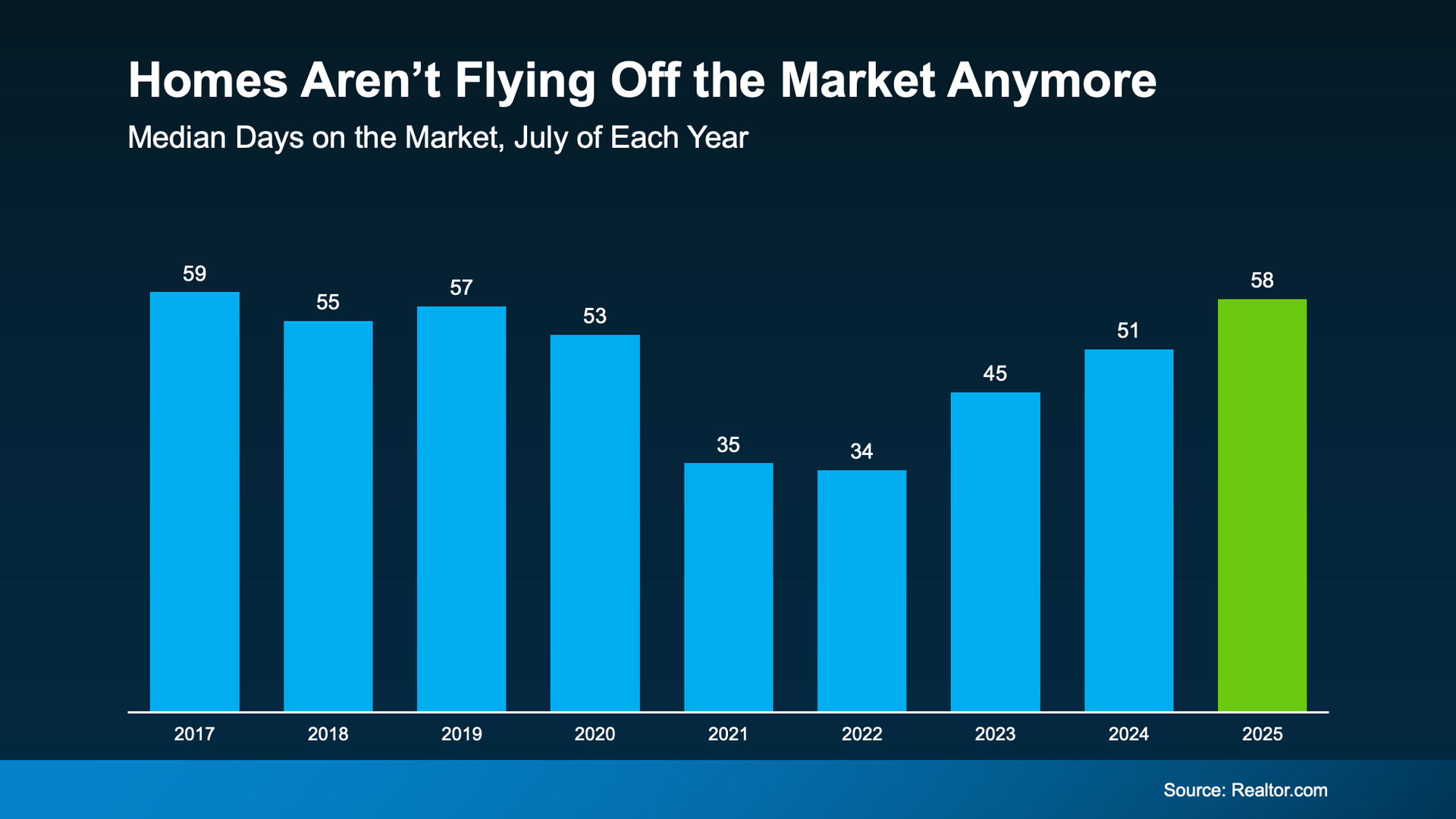
That means you now have more time to make decisions than you have at any point in the past five years. And that’s a big deal. Now, you’ve got:


Time to think.


Time to negotiate.


Time to make a smart move without all the pressure.


More Time Means Less Stress (and More Leverage)


Based on the data in the graph above, you have an extra week to decide compared to last year. And nearly double the time you would have had at the market’s peak.


Back then, fear of missing out drove buyers to act fast, sometimes too fast. Today, the pace is slower, which means you’re in control. As Bankrate puts it:


“For years, buyers have been racing to snag homes because of the fierce competition. But the market’s cooled off a bit now, and that gives buyers some breathing room. Homes are staying listed longer, so buyers can slow down, weigh their options and make more confident decisions.”


With more homes on the market and fewer buyers racing to grab them, the balance has shifted. Bidding wars aren’t as common, and that means you may have room to negotiate. And you can actually take a breath before you make your decision.


More listings + a slower pace = less stress and more opportunity


But, and this is important, it still depends on where you’re buying. Nationally, homes are moving slower. But your local market sets your real pace. Some states are moving faster than others. It may even vary down to the specific zip code or neighborhood you’re looking at. And that’s why working with an agent to know what’s happening in your area is more important than ever. 


To see how your state compares to the national average (58 days), check out the map below:
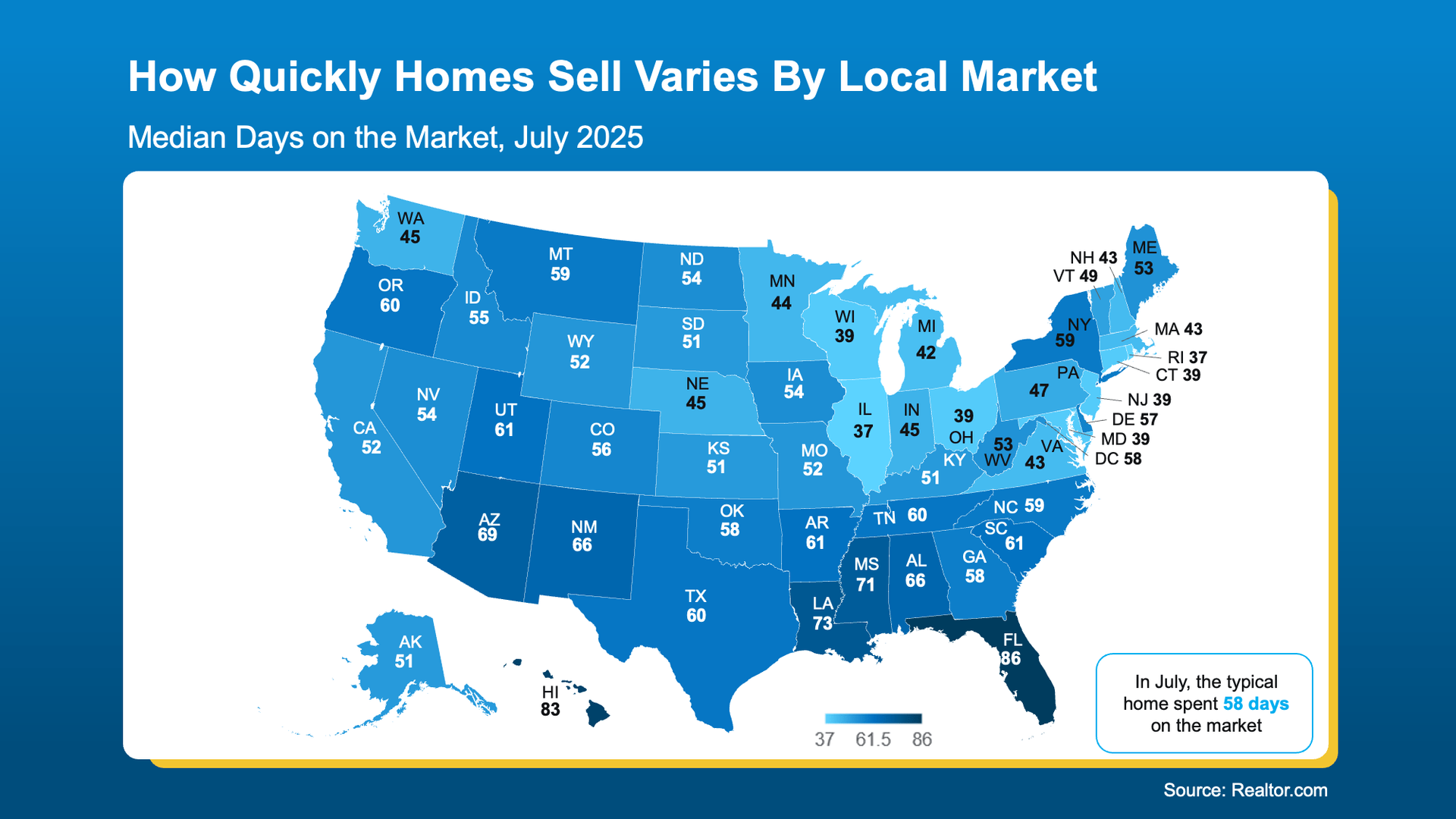
As Realtor.com explains:


While national headlines might suggest a buyer’s market is taking hold, the reality on the ground depends heavily on where and what you’re trying to buy. Local trends can diverge sharply from national averages, especially when you factor in price range, property type, and post-pandemic market dynamics.”


A smart local agent can tell you exactly when to move fast and when you can take your time, so you never miss the right home for you.


Bottom Line


If the chaos of the past few years drove you to hit pause, this is your green light. The market’s pace has shifted. You have more time. More options. More power.


And with the right agent guiding you, you’re in the best position you’ve been in for years.


Let’s talk about what the pace looks like in our area, and if now could be the right time for you to re-enter the market.


Couple standing in front of a house, red background with text:
January 30, 2026
Santa Clarita, CA first time homebuyers: Racquel Wilder - Pinnacle Estate Properties explains how a home that’s been sitting on the market can be a better deal.
Aerial view of a home with text
January 27, 2026
Need to “sell my home fast in Santa Clarita, CA”? Learn which home updates boost value and help you move quickly. Contact Racquel Wilder Realty today!
Couple with keys celebrating in front of a house; text:
January 15, 2026
Struggling between HOA vs No HOA? A realtor in Santa Clarita, CA from Racquel Wilder Realty breaks down pros, cons, and hidden costs. Reach out today!
Aerial view of suburban homes at sunset, with sun shining between clouds and along streets.
January 15, 2026
Wondering what to expect from the housing market in 2026? You’re not the only one. For the past few years, affordability has been the biggest barrier standing between most people and their next move. And a lot of buyers and sellers have been holding their breath waiting for things to get better. The good news? It’s finally happening. In 2025, affordability was the best it’s been in 3 years. And experts agree the momentum will keep going in 2026. And that’s based on their analysis of the key factors shaping the housing market in the year ahead: mortgage rates, inventory, and home prices. Lower Mortgage Rates Are Already Here Mortgage rates have already come down from their peak. By some counts, they dropped by almost a full percentage point over the course of the last year. And that’s a big deal, even if it doesn’t sound like it. But how low will they go? And should you wait for them to come down more? Here’s your answer. Forecasts suggest they’ll stay pretty much where they are now and hover in the low 6% range throughout 2026 ( see graph below ): 
Real estate agent speaking to a couple, couple appears unhappy in a white room.
December 11, 2025
Know the common selling mistakes and how the best realtor in Santa Clarita, CA, Racquel Wilder, helps you avoid them with smart pricing, timing, and strategy.
Two-story beige house with brown roof and garage, blue sky, and a real estate logo.
November 19, 2025
Discover how a trusted realtor in Santa Clarita, CA like Racquel Wilder Realty can help homeowners sell home fast. Contact Racquel Wilder Realty today!
Three people sit around a wooden table indoors, looking at a tablet.
September 12, 2025
Don’t wait. Selling a house needs the right price. A trusted realtor in Santa Clara, CA helps you market right and sell smart. Get a property evaluation today.
Wooden house model with question mark blocks on a light wood surface.
September 2, 2025
You may have seen talk online that new home inventory is at its highest level since the crash. And if you lived through the crash back in 2008, seeing new construction is up again may feel a little scary. But here’s what you need to remember: a lot of what you see online is designed to get clicks. So, you may not be getting the full story. A closer look at the data and a little expert insight can change your perspective completely. Why This Isn’t Like 2008 While it’s true the number of new homes on the market hit its highest level since the crash, that’s not a reason to worry. That’s because new builds are just one piece of the puzzle. They don’t tell the full story of what’s happening today. To get the real picture of how much inventory we have and how it compares to the surplus we saw back then, you’ve got to look at both new homes and existing homes (homes that were lived in by a previous owner). When you combine those two numbers , it’s clear overall supply looks very different today than it did around the crash ( see graph below ):
Two people giving a high-five; one woman smiles with a towel around her neck. Outdoors, sunny.
July 14, 2025
Are you a first time homebuyer? Read key advice to make your home purchase smooth. Reach out to Racquel Wilder, top Santa Clarita realtor, today.
Blue speech bubble with white quotation marks.
By Racquel Wilder May 28, 2025
If you're a first-time homebuyer, chances are you'll come across some terms you’re not familiar with. And that can be overwhelming, especially while going through one of the biggest purchases of your life. The good news is you don’t need to be an expert on real estate jargon. That’s your agent’s job. But getting to know these basic terms will help you feel a lot more confident throughout the process. Terms Every Homebuyer Should Know Once you’re familiar with this terminology, you’ll have a better understanding of important details – from contracts to negotiations. So, when those big conversations happen, you’ll feel informed, in control, and able to make the best decision for your unique situation. As Redfin puts it: “Having a basic understanding of important real estate concepts before you start the homebuying process will give you peace of mind now and could save you a fortune in the future.” Here’s a breakdown of a few key real estate terms and definitions you should know, according to the Federal Trade Commission (FTC) and First American. Appraisal: A report providing the estimated value of the home. Lenders rely on appraisals to determine a home’s value, so they’re not lending more than it’s worth. Contingencies: Contract conditions that must be met, typically within a certain timeframe or by a specified date. For example, a home inspection is a common contingency. While you can waive these to try and make your offer more competitive, it’s generally not recommended. Closing Costs: A collection of fees and payments made to the various parties involved in your home purchase. Ask your lender for a list of closing cost items, including attorney’s fees, taxes, title insurance, and more. Down Payment: This varies by buyer, but is typically 3.5-20% of the purchase price of the home. There are even some 0% down programs available. Ask your lender for more information. Chances are, unless specified by your loan type of lender, you don’t need to put 20% down. Escalation Clause: This is typically used in highly competitive markets. It’s an optional add on in a real estate contract that says a potential buyer is willing to raise their offer on a home if the seller receives a higher competing offer. The clause also includes how much a buyer is willing to pay over the highest offer. Mortgage Rate: The interest rate you pay when you borrow money to buy a home. Consult a lender so you know how it can impact your monthly mortgage payment. Pre-Approval Letter: A letter from a lender that shows what they’re willing to lend you for your home loan. This, plus an understanding of your savings, can help you decide on your target price range. Getting this from a lender should be one of your first steps in the homebuying process, before you even start browsing homes online. Bottom Line You don't need to have all these terms memorized, but a little knowledge goes a long way. Brushing up on the basics now means fewer surprises later – and more clarity when you buy a home. What unfamiliar real estate term or phrase have you come across that wasn’t on this list? Let’s connect and talk through it so you have a solid understanding of what it means and where it may show up in the homebuying process.